I am enjoying the iOS game Dots. It’s incredibly simple, which made it incredibly frustrating when I couldn’t reliably get about 130 points. Then, I talked to Tien, who gave me one simple trick that seems obvious now, but eluded me.
If you make a square of like-colored dots, it clears that entire color from the board.
With this, a few more tactics, and some luck, I managed to get 384 points. This isn’t a walk-through, but here are a few more tips I’ve picked up:
Always keep a reserve of the Shrinkers. They’re cheap (10 for 500 dots) and useful when you are one dot away from a square. I sometimes use 2-3 per round since I can replenish them in just a few games.
If you can make a square, don’t waste time connecting other adjacent like-colored dots; they’re going to get cleared anyway.
If you can’t get a single square in the first ten seconds, just start a new game. Doing well requires a string of squares in a row.
When you are on a roll, use a Time Stop. It’ll add 5 additional seconds and they’re not terribly expensive.
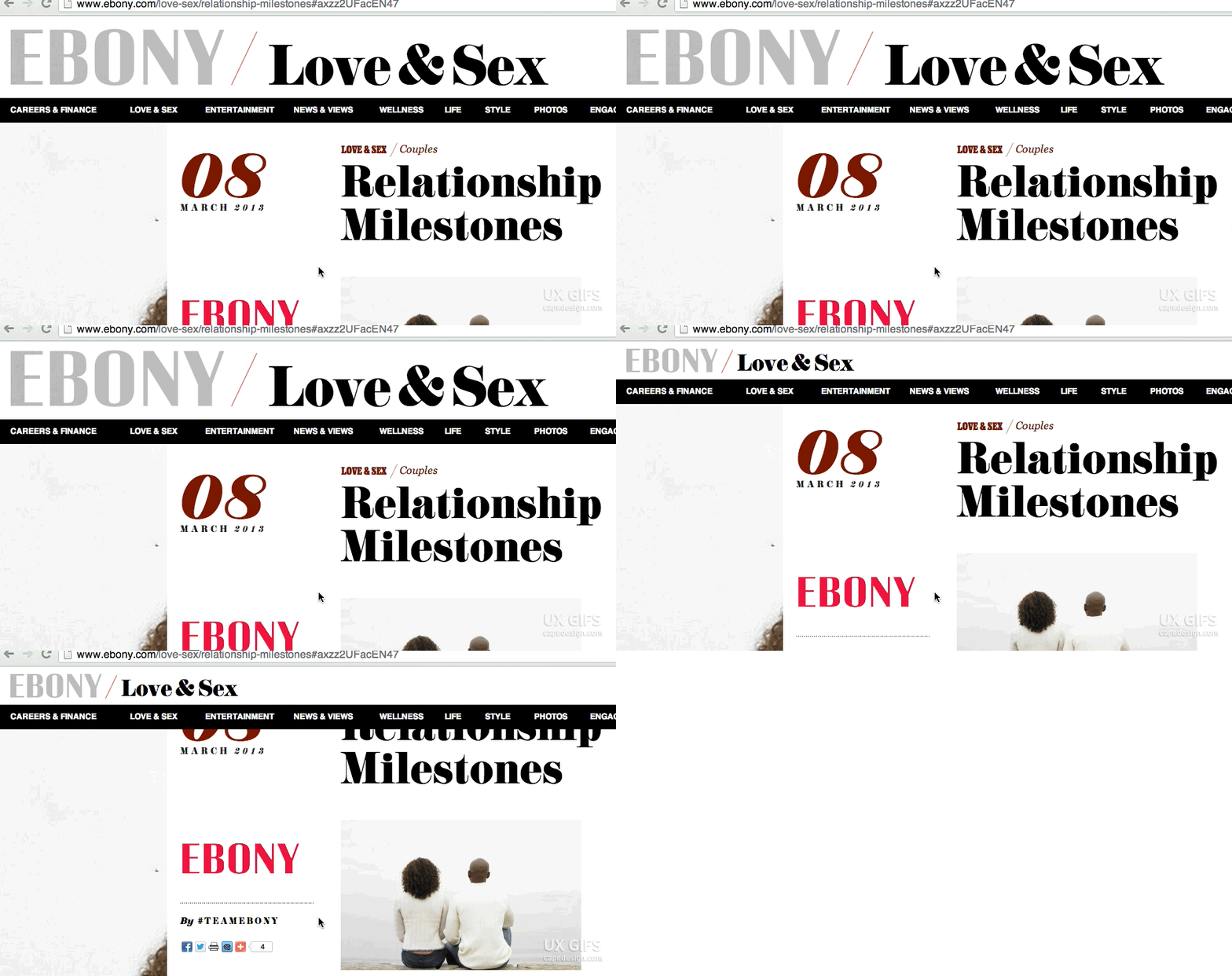
I am really digging the design of the now-digital internal magazine from Say (my former employer). It cribs a lot of style notes from recent online publications, but does so elegantly.
Andy Ihnatko, a respected technology writer, just posted several thousand words on why he switched to Android. Here are several hundred on why I would almost never recommended anyone purchase an Android phone.
If I get a call or text from someone asking what phone they should buy, I immediately know a few things:
They have good taste.
They’re not a power user. None of my geek friends need to ask.
They have limited knowledge of phones and don’t care to do intensive research.
They’re probably going to call me for tech support at some point.
They don’t care about what’s coolest, or the question might have been, “What do you think of the Galaxy SIII?”
This leads me to believe they want something that will just work. They don’t want to think about battery life or choosing the right [insert category here] app. This is Apple’s strong suit. By controlling nearly everything, they’re able to get the highest quality components and feel confident their phones will be reliable. They also have a clear, if waning, edge when it comes to apps.
While Apple certainly makes choices that aren’t right for everyone, accepting their point of view is less stressful than trying to uncover a solution. This is the opposite of Ihnatko’s take:
If I don’t like the way my iPhone works, I don’t hesitate: I search online. I can count on finding an answer. Not a way to make my iPhone work the way I’d like it to; rather, a Perfectly Reasonable Explanation of why Apple believes that the iPhone should work that way, and why it refuses to let me override the default behavior.
If I don’t like the way my Android works and I look online for solutions, I can usually find a way to change it.
In my experience, most people—at least the ones who ask for my advice—don’t bother to dig deep for solutions. They try the first search result or call a friend or Verizon or just go back to playing Fruit Ninja. If they were expert Googlers, they wouldn’t have come to me with such a broad question.
We are now past the novelty stage of smartphones. The average user wants to get technology out of the way and start seeing friends’ photos. Saving a couple hundred bucks or picking the phone that’s in stock isn’t worth it. Buy the one that’s going to work for another 3-4 years, is easy to set up, and is used by most of your friends. For Ihnatko, Android fits the bill and he’s probably ahead of the curve here. Today, for the people in my circle, the right phone is made by Apple.
While we don’t yet know if Netflix will be able to turn a profit on self-produced content, it seems pretty clear they’ll be guaranteed a hit. The NY Times wrote about how they knew House of Cards would do well.
Netflix, which has 27 million subscribers in the nation and 33 million worldwide, ran the numbers. It already knew that a healthy share had streamed the work of Mr. Fincher, the director of “The Social Network,” from beginning to end. And films featuring Mr. Spacey had always done well, as had the British version of “House of Cards.” With those three circles of interest, Netflix was able to find a Venn diagram intersection that suggested that buying the series would be a very good bet on original programming.
It’s not that Fox or Universal or whomever don’t have data, they just don’t have the same breadth of internal data that someone like Netflix or Amazon or Apple have. I really enjoyed watching House of Cards, but I’m more interested in how this model of publishing shakes up the industry.
David Friedman, proprietor of the always excellent Ironic Sans blog, has partnered with PBS to turn his photo series into a video series. The firsttwo videos are great. I’ll be a regular watcher.
This story is for bowling fans and bowling agnostics alike, as it’s really about a dude obsessed with perfection and competition. It’s also really well written and one of the best things I’ve read this year.
I was reminded of the story when I saw this Kickstarter, inspired by the article, show up in my inbox. I backed it (obvs).
This post is for David Jacobs and all baseball lovers. It is a quote from The Marriage Plot, a novel by Jeffrey Eugenides. Enjoy.
“You know what paradise means?” he asked.
“It doesn’t mean ‘paradise’?”
“It means ‘walled garden.’ From the Arabic. That’s what a baseball stadium is. Especially Fenway. A walled garden. Look how green it is! It’s so soothing to just sit here and look at the field.”
I just had my mind completely changed regarding Airtime. I thought the idea of a “platform for great video conversation” was unnecessary, but I would love it if I could turn on video based on what’s in the video.
I would like to be able to look at a directory of stuff. Things. A live-view of Niagra Falls. An original Star Wars movie poster. A 1976 Gibson Bicentennial Thunderbird. A living WWII Veteran. A demo of an OP-1.
Hell, I’d even love to connect to a Best Buy representative who could demonstrate the latests TiVos.
I feel a little bad about going into a Best Buy to check out TVs, but if they could let me check it out over online video, let me ask questions, and compare it to other units, then that’d be pretty fantastic. It also allows for a slightly smoother transition away from brick and mortar stores (at least until we all have 3D printers).
In what seems like crazy sci-fi, there’s a new type of pill that can tell your doctor whether or not you’ve taken it and the FDA just approved it.
With no battery and no sensor, it is powered by the body itself. The chip contains small amounts of copper and magnesium. After being ingested the chip will interact with digestive juices to produce a voltage that can be read from the surface of the skin through a detector patch, which then sends a signal via mobile phone to inform the doctor that the pill has been taken.
They mention that it’s not just about spying; it could also help doctors adjust dosage. A few more ideas that came to mind:
If grandpa doesn’t take his heart medicine at lunch, ring an alarm an hour later. If he doesn’t take it in two hours, text someone.
Implant these in vitamins (or broccoli!) and game-ify your kids health without all that pesky inputting.
Have the sensor know drug contraindications, so people who are on a variety of pills can be warned if they accidentally ingest something that could hurt them.
In a blog post on The New Yorker, Naunihal Singh points out that the media covered the shootings at a Sikh temple in Wisconsin very differently from the shootings at the movie theater in Aurora, CO.
[T]he massacre in Oak Creek is treated as a tragedy for Sikhs in America rather than a tragedy for all Americans.
I agree with his post completely, especially that the media has an obligation to educate its viewers and inspire them to right wrongs. He puts it plainly.
Sadly, the media has ignored the universal elements of this story, distracted perhaps by the unfamiliar names and thick accents of the victims’ families. They present a narrative more reassuring to their viewers, one which rarely uses the word terrorism and which makes it clear that you have little to worry about if you’re not Sikh or Muslim.
Unfortunately, Singh didn’t spend much time discussing why the media covered it this way, which is equally important.
It’s frustrating and depressing that this country has a history of racist violence, but the problem is one we know. It’s easier to understand and feels like something we can avoid, even if that’s because our looks and beliefs align with the mainstream.
When a person goes into a crowded movie theater and guns down people at random — without any explanation or note — and leaves his apartment booby-trapped for law enforcement, that’s something nearly impossible to fathom or predict. It’s frightening to think that you could happen upon this at any given time without any explanation.
It’s depressing, but the twist logic of Wade Page and the murders he committed in Oak Creek didn’t surprise me. Even as cultural and religious tolerance improves, it’s been the source of much of the violence in recorded history and I don’t see that trend fading quickly. The ones in Aurora are something relatively new and, seemingly, uniquely American. It’s a disturbing trend and a new source of fear, which explains why we spent so much time trying to understand it.
I’m a big fan of slow news. There are some things that are great to know right away, either because you need to act on them quickly or it’s fun to discuss in realtime at the web’s water cooler. This has left a lot of important stuff, stuff that may not be conducive to a rapid-paced news cycle, at the wayside. This is why I am excited about Evening Edition.
As the creators explain, it is “the perfect commute-sized way to catch up on the day’s news after a long day at work.” They provide a paragraph of text on a handful of stories that is just enough to help you understand what happened. It’s only a day old, but I lurve the concept and the first edition was tight.
Tangentially, Andre is letting the parade march by. Leaving social media can be like paddling your kayak from the center of a roaring river to the edge, but a lot of people I respect have started to consider a world away from the rapids. I’m hoping we all find some balance.
“Why did you think she needed a haircut?” ” It was almost down to her tush. If she grew it any any longer, her hair would go into the toilet and it would be gross.” You should listen because these girls are freaking adorable.
I have long thought it’d be fun to reproduce fast food ads, keeping everything the same except I’d swap the product photo with one of from a burger I’ve purchased. We all know the end result does not look the same, but this video shows how much lighting and retouching makes a difference. When you style up any old Quarter-pounder, it ends up looking pretty good.
While the video is entertaining, it doesn’t make me feel better or less manipulated. The difference between reality and the ad is too great, which leads to disappointment. Of course, McDonald’s is trying to sell a product and they are going to do what it takes to maximize sales, but it’s not helpful to the consumer.
It’d be great if, just like standardized nutritional information, there was standardized product marketing. Every burger had to be photographed in the same studio; every phone had to show the same set of features; every airline had to display their average hold times and delay length. It’d be maddeningly difficult, if not impossible, but realistic expectations would make consumers happier in the long run and force corporations to build better products. [via kottke]
Most web designers are familiar with the pains of creating image sprites for their icons. It’s easier with things like LESS, but still, sucks. The good folks at Oak Studios have created an icon set that is built into a font (a growing trend), which uses ligatures to insert the icons. For example, if you type “heart”, it will automatically insert the icon for a heart. Pretty smart.
In said piece, Paul tackles time, its relative value, and your control over it. He also manages to write it beautifully, which I hope you’ve grown to expect.
There are 200 of you in this auditorium. So every minute I don’t talk saves about three-and-a-third hours of human time. That’s a pretty serious ratio. Every one of my minutes is collectively 200 of yours.
I’ll try not to give away the big reveal, but it’s a story of a hands-on CEO who benefits from doing the right thing.
I climbed out of bed, closed the door behind me, and spent the next two hours coaching Bob on how to configure the start-up options for Microsoft Windows. It wasn’t an issue with our software, but it was a problem for our customer, Bob-which made it our problem. At the end of the conversation, I thought we’d made a lot of progress. Bob was enthusiastic. I was hopeful.
The story also reminds you that successful companies are built very slowly. You’ll read that just about everywhere (except for Tim Ferriss books), but it can’t be said enough. Paying attention to details, having patience, and treating your customers like humans will almost always lead to success.